

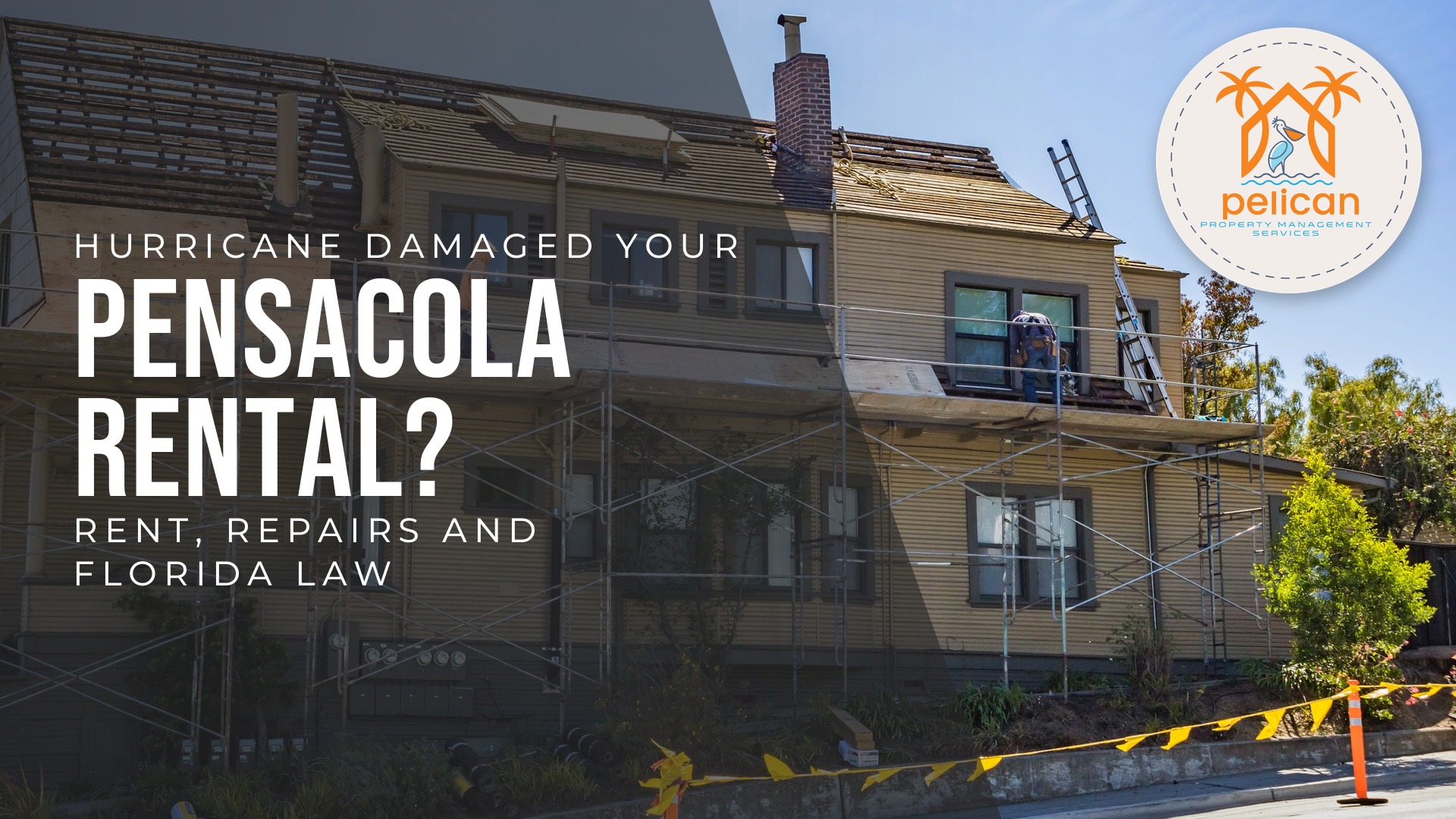
What Florida Statutes Chapter 83 asks of Gulf Coast landlords after the October 2026 storm, and what I would do this week
Disclaimer: We are not attorneys. Pelican Property Management is a property management company, not a law firm. This article is for educational purposes only and is not legal advice. Talk with a qualified Florida attorney before you act on anything here.
Quick answer: If Hurricane Isaias left your rental so damaged that your tenant cannot reasonably live in all or part of it, Fla. Stat. 83.63 lets the tenant end the lease and move out, or stay and pay reduced rent for the unusable part. If the lease ends, the 83.49 deposit deadlines apply, and the tenant must get a safe chance to collect belongings. Your job: stop further damage, report the claim, hire licensed contractors, give notice before entering, and put everything in writing.
The rest of this post is for owners in Escambia and Santa Rosa counties still sorting through roofs, wet drywall and tenant texts weeks after the storm.
What actually happened on October 9
According to the National Hurricane Center, Isaias made landfall near Destin around 8:30 PM CDT on Friday, October 9, 2026, as a Category 2 hurricane with maximum sustained winds of 105 mph. That was about 40 miles east of Pensacola, and we still got hit hard. The NHC logged a 100 mph gust at a station near Pensacola, and the National Weather Service office in Mobile reported gusts of 114 mph at Whiting Field South and 116 mph at Oriole Beach, widespread rain of 5 to 8 inches, and a peak water level of 2.73 feet at the Pensacola gauge.
On October 21, FOX10 reported that Mayor D.C. Reeves estimated private property damage inside Pensacola city limits at $71.7 million, with debris removal running in two passes of four to five weeks each.
The rent question comes first, so start there
Two questions come up first: does the tenant still owe rent, and can the owner end the lease to repair in peace?
Florida answers the first in 83.63. The statute applies when the premises are damaged or destroyed by something other than the tenant's wrongful or negligent acts, and the damage substantially impairs the tenant's enjoyment of the home. A hurricane is the textbook case. The tenant then has two options:
- Terminate the rental agreement and immediately vacate, or
- Move out of only the part of the home made unusable and keep living in the rest, with rent reduced by the fair rental value of the damaged part.
Notice who holds the choice: the tenant. The statute does not, by itself, give you a right to cancel the lease for casualty damage. Some leases have their own casualty clause on landlord termination; whether yours does, and whether it holds up, is a question for your attorney.
"Substantially impaired" is not defined with a number. A missing fence panel probably does not qualify. A roof open to the sky over two bedrooms probably does. The middle ground, like a soaked living room with a working kitchen, is where disputes start, and where a partial rent reduction often beats a legal fight.
The 2025 change most owners missed
In 2025 the Legislature passed SB 180, which became Chapter 190 of the 2025 Laws of Florida, and it amended 83.63. The termination and rent reduction language stayed the same. What was added is a new subsection that says the tenant must be given either:
- The opportunity to collect his or her belongings from the premises when it is safe to do so, or
- Notice of the date by which the tenant will be able to collect belongings, and that date must fall within a reasonable time.
So you cannot leave a tenant's furniture in limbo while you wait on an adjuster. If the structure is unsafe, put a date in writing and keep it. Nobody in our area has much experience yet with how "reasonable time" gets read after a storm this size.
Deposits when a lease ends because of the storm
If the tenant terminates under 83.63, the statute points you straight to Fla. Stat. 83.49(3). The usual clock applies. Return the deposit within 15 days if you are not making a claim, or send written notice of your intended claim within 30 days, by certified mail or by email if the tenant agreed to email notices under 83.505. Miss the 30 day window and you lose the right to claim against the deposit.
Here is the part that trips people up after a storm: wind and flood damage is not tenant damage. You cannot deduct a new roof, wet carpet or storm debris cleanup from a deposit. You can still claim for damage the tenant actually caused before the storm, the same way you would at any move out. Our guides to Florida security deposit laws and wear and tear versus tenant damage walk through that line. Also refund any rent paid for days after the termination date.
Your repair duty, and the tenant's withholding option
Storm or no storm, Fla. Stat. 83.51 still requires you to comply with applicable building, housing and health codes, or where none apply, keep the roof, windows, doors, exterior walls, foundation and other structural parts in good repair and the plumbing in reasonable working condition. For a single family home or duplex, the lease can modify some of these duties in writing, so reread yours.
If a tenant stays in the home and believes you are not meeting 83.51(1), Fla. Stat. 83.60 lays out the rent withholding route. The tenant must deliver written notice that describes the problem and says they intend to withhold rent, and then wait 7 days. If you later file for possession over unpaid rent, a material noncompliance can be a complete defense, and the court decides how much rent should be reduced. The tenant generally has to deposit rent into the court registry to keep that defense alive.
So when a written repair notice comes in after Isaias, treat it like a deadline, because it is one. Reply in writing, give a realistic schedule, and log every contractor visit. A dated paper trail beats silence.
My judgment call on this: when the repair will take weeks and the tenant is living with a tarp and a dehumidifier, I would rather offer a modest written rent reduction early than wait for a withholding notice. The cost is real money out of your pocket that insurance may not reimburse, and some owners will disagree with me. What you buy is a tenant who keeps the home ventilated and lets contractors in, and a lot less risk of a messy possession case later.
Getting in the door for repairs
Fla. Stat. 83.53 lets you enter at any time to protect or preserve the premises, which covers true emergencies like an active leak or a tree through the roof. For ordinary repairs, you need at least 24 hours of notice and must enter between 7:30 AM and 8:00 PM. The statute also says you cannot abuse the right of access or use it to harass the tenant.
Contractor schedules after a hurricane rarely respect that. Ask the tenant in writing for standing consent covering a specific list of repair visits. Most tenants want the house fixed as badly as you do.
Insurance: your policy, their policy, and the clock
Your landlord policy, usually a dwelling fire policy such as a DP3, covers the building. It does not cover the tenant's couch, clothes or TV. That is what renters insurance is for, and if your tenant did not carry it, their personal property loss is generally not your problem to pay. Flood is a separate policy entirely. Standard landlord and renters policies typically exclude flood, so check whether your property carries NFIP or private flood coverage.
The deadline matters. Under Fla. Stat. 627.70132, a new or reopened property claim is barred unless you give notice to your insurer within 1 year after the date of loss, and a supplemental claim within 18 months. For hurricanes, the date of loss is the landfall date. For Isaias, that is October 9, 2026. Do not let that deadline become your plan. Report now, while photos are fresh and adjusters are in the area.
A few things that make claims go smoother:
- Photograph and video every room, the roof, fences, the yard and the exterior from all sides, with date stamps, before anything is removed.
- Keep damaged materials or samples until the adjuster has seen them, unless they are a health hazard.
- Mitigate. Your policy almost certainly requires reasonable steps to prevent further damage, like tarping and drying out. Keep receipts.
If you took the baseline video from our hurricane prep checklist, send it to your adjuster now.
Mold is the clock you cannot see
The EPA says wet materials dried within 24 to 48 hours usually will not grow mold. Many Isaias homes are well past that window. The EPA also suggests getting professional help when mold covers more than about 10 square feet. In Florida, mold assessors and mold remediators are licensed by DBPR, so verify them the same way you would a roofer.
Do not paint over stains or close up walls before the cavity is dry. Mold that shows up three months into a lease turns into a habitability dispute, and you will be back to 83.51 and 83.60.
Contractors, permits and the people knocking on doors
During a declared state of emergency, contracting without a license in Florida is a third degree felony under Fla. Stat. 489.127.
The Florida Department of Business and Professional Regulation keeps a storm recovery page for Isaias with red flags: full payment upfront, pressure to act now, cash only, and offers to "handle" your insurance claim. Before anyone touches your roof, run their name through the DBPR license lookup.
Permits matter too. The City of Pensacola is taking applications through MGOConnect, told owners to begin storm related emergency repairs,, and requires contractors to hold a city Business Tax Receipt. Escambia County lists minor repairs that need no permit, like tarping and drywall removal, and will enforce the FEMA 50 percent rule for substantially damaged homes in flood zones. On Pensacola Beach, the Santa Rosa Island Authority signs off first.
FEMA and SBA: what exists for rental owners
On October 9, FEMA approved an emergency declaration for Florida (declaration 3655) that supports government response work, not payments to households. On October 16, the state requested a Major Disaster Declaration that asks for Individual Assistance in eight counties, including Escambia and Santa Rosa. When I wrote this in late October, WEAR reported that request was still awaiting federal approval. Check FEMA's site for the current status.
Even if Individual Assistance opens, FEMA housing help is aimed at a person's primary residence and their own belongings, not a landlord's rental building. Your tenants may qualify for help with temporary housing and personal property through DisasterAssistance.gov once registration opens. For owners, the more relevant option after a major disaster declaration is usually the SBA physical damage loan program, which says qualified rental properties may be eligible under its business loans.
The disclosure you will sign next spring
This storm will follow your property for years. Fla. Stat. 83.512, in effect since October 2025, requires a separate flood disclosure for any lease of one year or longer, signed at or before lease signing. The form asks whether you know of flooding that damaged the unit during your ownership, whether you filed a flood insurance claim (including NFIP), and whether you received flood assistance, including from FEMA.
"Flooding" in that form means rising inland or tidal water, rapid runoff, or sustained standing water from rainfall. Water that came through a torn roof is generally treated differently from water that came in under the door, so be precise about what happened at your property. If Isaias pushed water into your unit, the honest answer on your next lease is yes. Lying or skipping the form has teeth: if a later flood causes the tenant a substantial personal property loss, they can terminate within 30 days and get prepaid rent back. Write down what happened, which rooms, and any claim numbers now.
When to call an attorney
I would pick up the phone to a Florida landlord tenant attorney if:
- The tenant says the home is uninhabitable and you disagree.
- You want to end the lease yourself because of the damage.
- You receive a 7 day withholding notice under 83.60.
- Your insurer denies or lowballs the claim and you are considering a dispute.
- You are thinking about an eviction for nonpayment in a home with open storm damage.
On that last one, our post on handling tenant nonpayment in Florida covers the normal process, but a damaged house changes the tenant's defenses. For background, see Florida landlord tenant laws in 2026.
Owner checklist for the weeks after Isaias
- Confirm everyone is safe and ask the tenant, in writing, whether they are staying, leaving, or moving out of part of the home.
- Document every room and the exterior with date stamped photos and video before cleanup.
- Tarp, dry out and secure the property, and save every receipt.
- Report the claim to your landlord insurer, and flood carrier if you have one. The latest notice date is one year from the October 9, 2026 landfall.
- Give at least 24 hours of notice for repair entry, between 7:30 AM and 8:00 PM, unless it is an emergency.
- Verify every contractor and mold professional through DBPR and confirm permits with the city or county.
- Reply in writing within days to any repair or withholding notice.
- If the lease ends under 83.63, give the tenant a safe date to collect belongings and run the 15 and 30 day deposit deadlines.
- Keep a written record of any flooding and claims so your next 83.512 disclosure is accurate.
- Check FEMA and SBA status for Escambia and Santa Rosa counties before assuming any federal help is available.
If your rental is in one of our service areas and you are sorting through any of this alone, call us. The debris trucks are still on their first pass, and the claim deadline is October 9, 2027.